

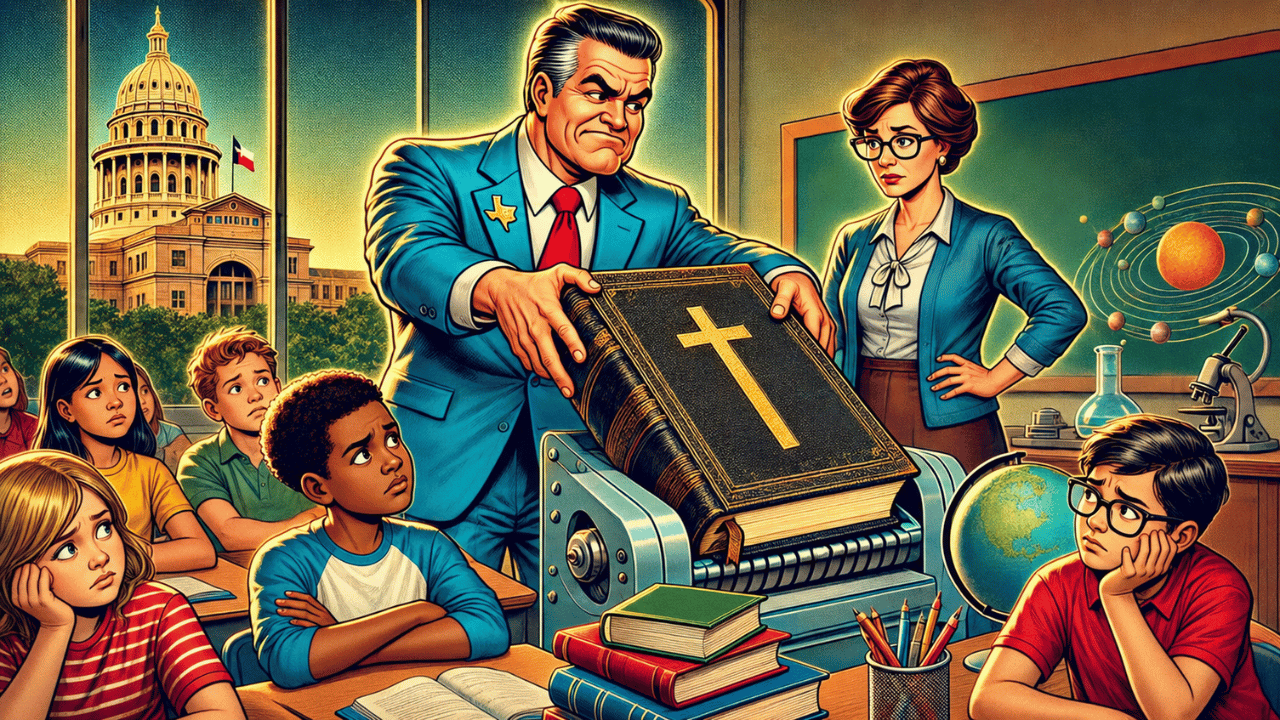
Texas has taken another significant step toward blurring the Constitutional line between church and state after the Texas Board of Education voted to require Bible stories as part of a mandatory reading list for the state’s public schools. The decision affects more than five million students and continues a growing effort by Texas lawmakers and education officials to weave Christianity more deeply into taxpayer-funded classrooms. Beginning with elementary grades in 2030, students will be required to read selected passages from the Bible alongside other literary works.
The vote, which passed along largely party-line lines, follows a series of recent actions by Texas officials promoting Christianity in public education. Last year, the state enacted a law requiring the Ten Commandments to be displayed in every public school classroom. Officials have also encouraged districts to adopt Bible-infused instructional materials through financial incentives. Critics argue these measures are part of a coordinated campaign to normalize government-sponsored religion in schools rather than simply teaching about religion as an element of history or literature.
Supporters of the new reading list insist that Biblical stories are historically important and provide students with a better understanding of Western civilization and American history. They argue that familiarity with figures such as Moses, Abraham and Jesus helps students interpret literature, art and historical references found throughout Western culture. State education officials have framed the curriculum as educational rather than devotional.
However, this justification is nonsensical, as the Bible is not an accurate historical record of world history events. It is a series of religious legends and myths that surround some historical events, but are not faithful presentations of those events. Furthermore, the First Amendment prohibits government establishment of religion, a principle intended to protect believers and nonbelievers alike from state-sponsored religious instruction. Public schools serve children from Christian, Jewish, Muslim, Hindu, Buddhist, Sikh and many other religious backgrounds, as well as families with no religious affiliation, such as Atheism. Requiring one religion’s sacred text to receive special treatment inevitably raises questions about whether the government is favoring one set of beliefs over all others.
For Atheists and other secular Americans, the decision represents another reminder that political efforts to privilege Christianity continue to gain momentum in several states. Government neutrality toward religion has long been a cornerstone of American constitutional law because it protects everyone equally. Christians remain free to teach the Bible in churches, homes and private religious schools. Public education, however, exists to serve students of every worldview without placing the government’s authority behind any particular faith.
However, the Texas laws are unlikely to withstand legal challenges. Last December similar laws in Oklahoma were struck down and in June of last year, a similar law in Louisiana was struck down by the federal courts. Texas falls under the same federal court jurisdiction that struck down the religious school laws in Louisiana and that will almost certainly be the same outcome in this case again. Texas state officials must certainly realize this, and are expecting to make an appeal to the Supreme Court. However, the Supreme Court has previously ruled in Engel v. Vitale (1962) and Abington School District v. Schempp (1963) that states cannot force students to read Bible passages in public schools. It is not likely to take up the case again as the matter has already been decided by previous Supreme Court justices making a plain reading interpretation of the First Amendment. Christian fundamentalist politicians have often pointed to the Supreme Court’s overturning of Roe V Wade as proof that the Supreme Court can change its opinion on issues, however, this is different situation as abortion is not outlined in the Constitution the way that a prohibition on state mandated religion is. There is no legal justification for the Supreme Court Justices to completely ignore something that is so plainly outlined in the Constitution as a thing the government cannot do.
Nonetheless, for millions of Texas students, the classroom has become the latest battleground in America’s ongoing struggle over religious freedom.
Source URL: https://www.cnn.com/2026/06/26/us/texas-schools-bible-curriculum-vote